Biometrics for access control
Face, palm and dynamic QR authentication with liveness and spoof detection — at every door, integrated with your existing ACS.
Tricsy replaces badges and PINs with a single biometric identity — access control, real-time zone security and visitor onboarding, for a building that is smarter, safer and completely friction-free.
In use at


From the pavement to the desk, one biometric layer runs every touchpoint — resolving an identity where access needs one, and only anonymous, aggregated data where it does not.
Face, palm and dynamic QR authentication with liveness and spoof detection — at every door, integrated with your existing ACS.
Fast, remote or on-site visitor enrolment with identity verification and time-limited access — no badges, no waiting at the desk.
How visitor onboarding worksOne identity for meeting rooms, parking, lockers and elevators — a frictionless, personalised experience across the whole building.
Multi-camera tracking evaluates whether a person is permitted to stay, with an automatic incident escalation path and integration across systems.
Live occupancy books the room nobody reserved and releases the one nobody turned up to — and the minutes arrive automatically, for the meeting’s participants.
Aggregated gender, age and dwell time — never an identity.
How audience measurement worksNinety seconds in the building Tricsy runs every day — the same doors, turnstiles and rooms described above, working. Seamless and touchless, for everyone who moves through it.
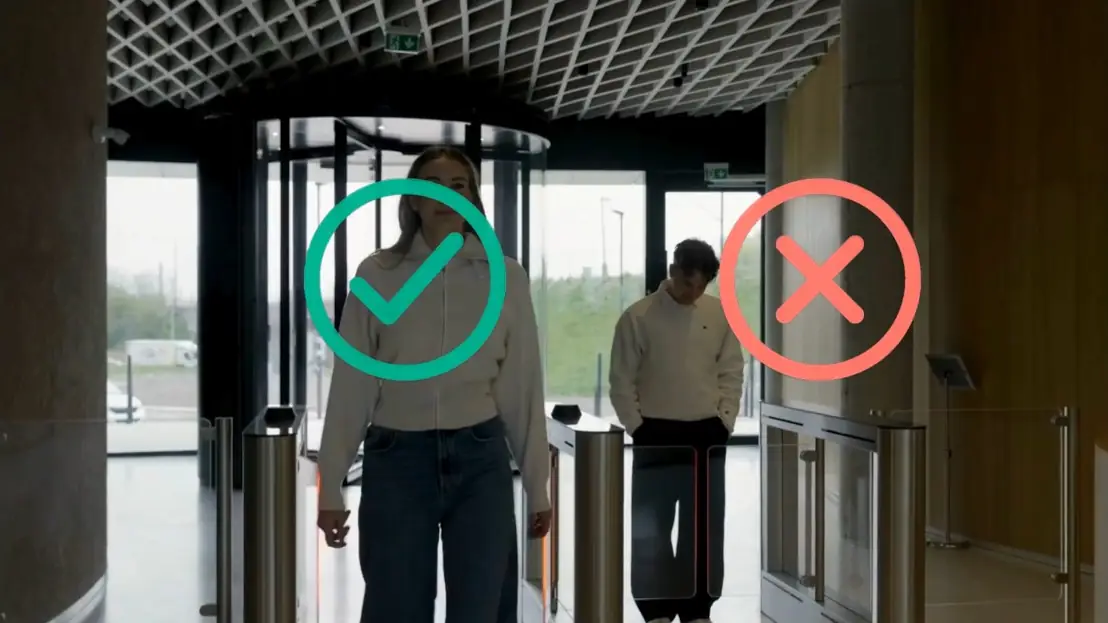
Every door reads a face, a palm or a QR code at a distance — the camera that makes it harder to fool is what makes it faster to walk through.
People enrol once. After that the building recognises them — at the turnstile, the meeting room and the elevator — without a badge, a PIN or a queue at reception.
Tricsy adds a biometric identity layer on top of the access control, elevators, gates and workplace tools you already run — not a rip-and-replace. A few of the platforms we already speak to:



Running something that is not on the list? Tell us what it is — the integration layer is where we do most of our work.
A biometric identity is worth more when it reaches the screen your security team is already watching. We have written plugins for Nx Witness, Milestone XProtect and LENSEC Perspective VMS — each one its own project, shaped around what that site actually needed.


If you run one of these — or something beside them — tell us what you run and what you would want to see in it. The conversation starts from experience rather than from zero.
Recognition has to happen somewhere, and there are two places to put it. Where it runs is what decides how much server you end up owning.
If it sends RTSP, the server can read it — which is almost every IP camera sold in the last decade, so there is no compatibility list to check yourself against. Nothing on the wall has to change, which is usually the point.
The cost is linear. Every camera you add is server capacity you add.
Detection, extraction and matching all run on the device. What leaves it is the answer — who was seen — not the footage. That is a smaller bill and a much shorter privacy conversation.
The work spreads across the estate instead of piling onto one machine, so the server stops growing with the camera count. Hundreds of cameras, one modest server.
Cameras and AI boxes that can do it on the device
 Face · Palm · Pedestrian · QR
 Face · Palm · Pedestrian · QR
On-device recognition needs a camera with the silicon to do it — Ambarella, Rockchip or NVIDIA Jetson. Which models qualify is a moving list and a short conversation, so ask us and we will go through it against what you already run.
No. Tricsy adds a biometric identity layer on top of the access control, cameras and networks you already run, rather than replacing them.
Biometric templates are encrypted, and deployment options include keeping them on your own infrastructure — with on-device processing, they never leave the camera at all. Audience measurement is the exception: it stores no biometric template.
The recognition algorithms are developed in the EU and built to be operated in line with the GDPR. That matters more than it sounds: it decides who holds the data, under which law, and whose answer you get when a regulator asks.
Access is denied by default and the event follows a defined escalation path — a fallback method, a human check, or an alert to the security team, depending on the zone.
They enrol before arrival or at a self-service point, receive time-limited access to only the zones they need, and never queue for a badge at the desk.
Tell us how we can help with biometrics and we will get back to you.
We read every message, then reply with next steps — usually a short call to understand your building and its systems.